
3 of 3 -The Day the Fog Spoke and How the Fog Lives in ToneStream
The Day the Fog Spoke: A Childhood Moment, Part 3 A Foundation for ToneStream -Michael Joly When I listen to ToneStream now,...
Read article

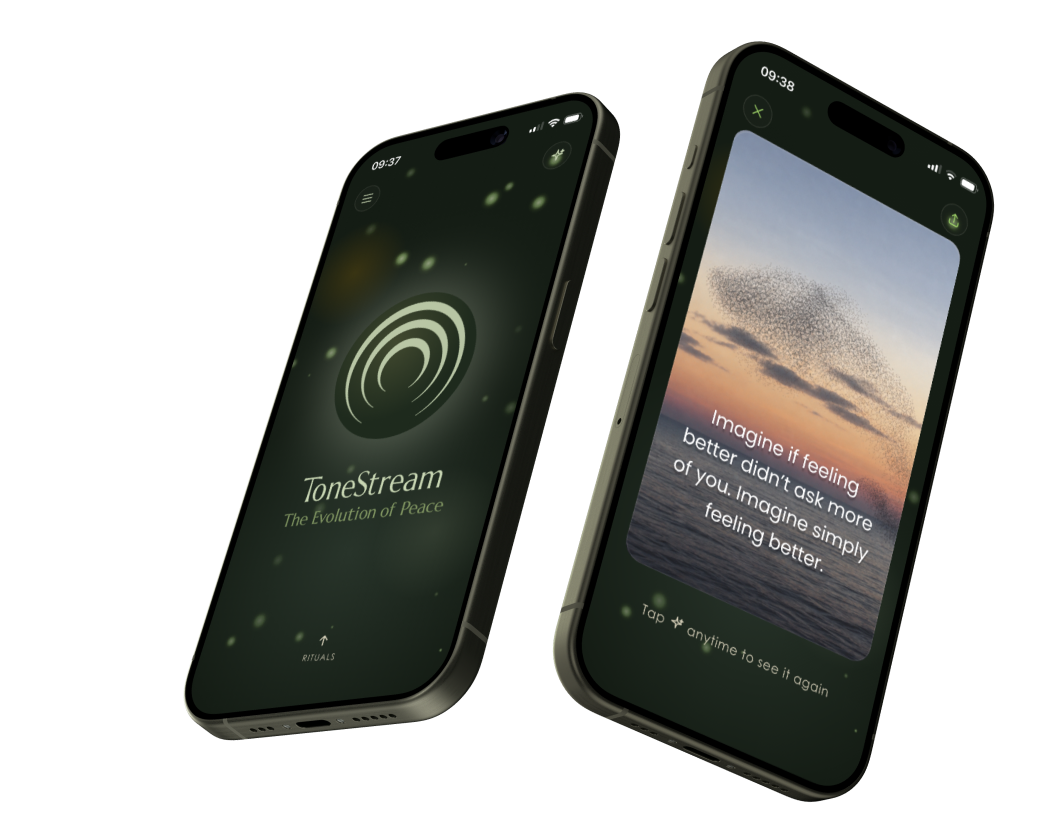
Tap an image to play. For best results listen on earbuds, headphones or good speakers. ToneStream always evolves as it streams live to listeners around the world, it’s unity-making and also personal to you. The recordings here present what ToneStream sounded like in the past. Subscribe, listen, and be a part of the live Evolution of Peace – as it sounds now.

ToneStream has no voice-guided sessions, no playlists and no goals. Instead, a continuously evolving stream of harmonically-coherent sound offers an invitation to play with life a little more easily.
It offers opportunities for repose, growth and integration. Because every moment of ToneStream is unique, and people are different, it will land differently for each person listening. Each time you listen.
ToneStream is not a meditation app. It's a new frontier in functional sound.
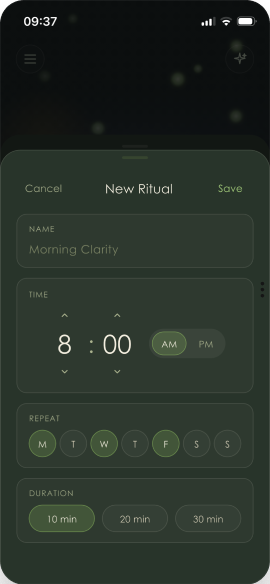
We make it easy and pressure‑free to listen as long or as briefly as you like.
Create your own timed sessions for classes, sleep, meditations, work breaks, baby nap times, study sessions and more.
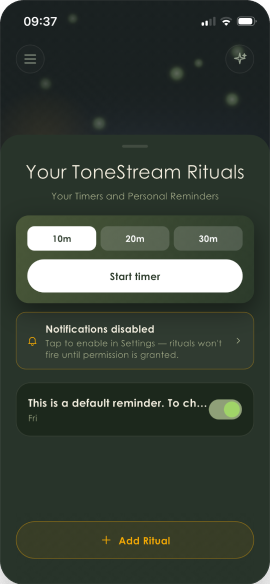
If you’d like a gentle nudge to pause and take a break, ToneStream allows you to set reminders to step away, listen and recenter.
These reminders can be scheduled for specific times, or set to appear randomly throughout your day.
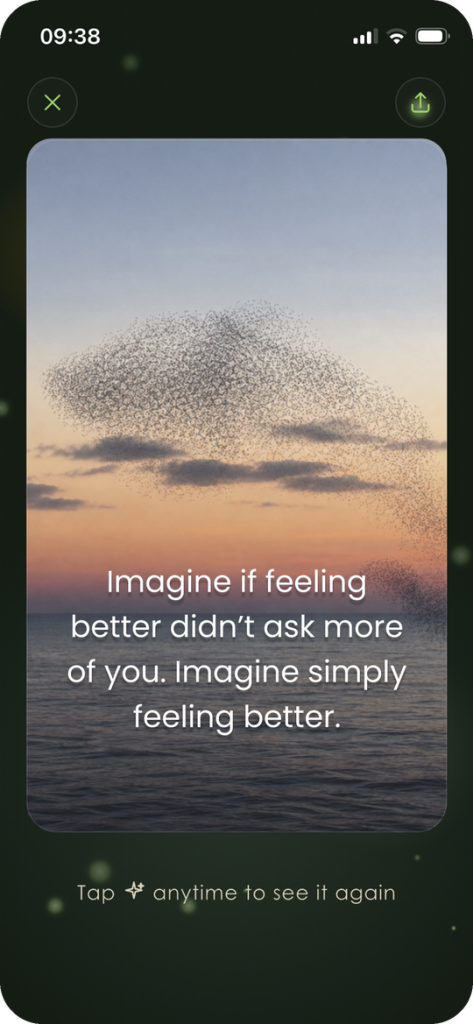
A fresh daily note for contemplation, thoughts about ToneStream's connection to you and peace, and reminders of where your listening can take you.
We call ToneStream "The Evolution of Peace" because we believe peace is still evolving––still emerging in the world. And evolution, in the listener and in the culture may be fostered through the effects of peace. A virtuous circle of positive evolution. Start with a few quiet minutes... and watch it grow.
You need and deserve good sleep. ToneStream doesn't use voices, words, or normal music. Instead, its slow-moving, harmonically-coherent sounds can be a lovely accompaniment to your sleep hygiene routine.

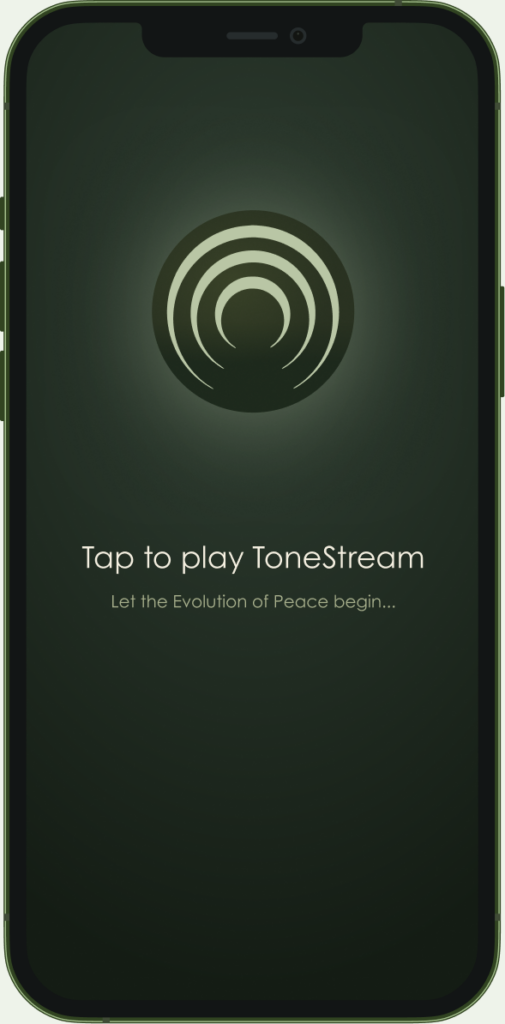
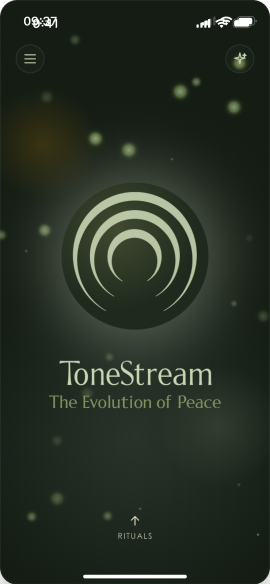
Just tap the Solu arcs and listen. No searching for the right voice or the right story. No scrolling. No voices, no insistent noise. Rest your eyes and bathe in the pure sounds of the slow moving ToneStream: The Evolution of Peace.

ToneStream is a live experience. As you listen, new connections in sound are forming in real time, and others around the world are listening in the same moment. Together, you share an evolutionary encounter with peace, with yourself, and with a connected world.

Imagine not needing to carve out time to meditate today. Just invite the ever-changing sounds of ToneStream into your world, and go about your day: sit, walk, read, work. Let the sounds keep you company. The Evolution of Peace can be easy: just play.
Sound thinking from Michael and Alene
Try with no risk at all — your first 7 days of ToneStream are free!
7-day free trial. Cancel anytime.
Unlimited access to all ToneStream features.
Start 7-day free trial Unlimited access to ToneStream
 Legacy Solu tones offline
 Set play times
 Set reminders
Share The Evolution of Peace, connection, and a new way forward with someone special.
One-time purchase · No subscription
Buy a giftYou’ll get a gift code to share after purchase.
How to redeem Gift CodeToneStream is a functional sound app: a live stream of slow-moving tones, swells and drones, arranged in real time as it plays. No moment repeats exactly.
The sounds are hand-played on real instruments and tuned to the simplest ratios of the harmonic series. The instruments are metallophones, flutes made from Japanese knotweed, and bowed and fingerpicked guitars. No AI is used to make them.
There is no voice guidance, no lessons and no goals. Tap the Solu arcs and you join the stream wherever it happens to be. Listen for a minute or for a day.
We call it The Evolution of Peace. Think of it as a metaphor and a hope: that peace is still emerging, and that each quiet moment may make the next one a little easier to find.
Listeners describe ToneStream as a place to begin the day, a bridge from inner work back to ordinary life, and somewhere to return when the world gets loud.
ToneStream may sit near meditation apps and sound baths, but it’s neither.
There’s no guide, no playlist, no instructions and no streak to keep. You don’t pick a goal or work on anything. One stream of sound plays, and you listen, as closely or as loosely as you like.
Meditation apps usually ask you to do something. ToneStream simply offers somewhere to be.
Listeners tell us they come away calmer, clearer or more rested. We take those reports seriously and keep refining ToneStream because of them. But it lands differently for every person, every time, and we’d rather you find out for yourself.
Expect slow sound that never hurries you: bright struck tones, long fading tails, low drones, and now and then a silence of a few seconds.
Many listeners say their mental chatter quiets within a few minutes. Some notice an unprompted deep breath. Others describe more clarity, steadiness or rest. Some simply enjoy it as music. All of these are fine.
There’s nothing to perform and nothing to achieve. Here’s one thing we’ve noticed, and you may too: it’s hard to listen closely and keep thinking at the same time. Intentional attention to listening tends to turn down the volume of mental noise and reactivity.
We like to imagine that one calmer person makes for calmer conversations, and that peace grows that way: first within a person, then between people. That’s our hope, not a promise.
ToneStream is made for relaxation and attention. It isn’t a medical treatment and doesn’t replace care from a professional.
There’s no single right way.
For the best sound, use headphones, earbuds or good speakers. Wired is better than Bluetooth, and Bluetooth is better than not listening. Phone speakers can’t reproduce the low tones well. Two speakers spread apart in a room sound wonderful.
Play it softly in the background and it becomes a kind of glow in the room, a scent made of sound. Listen closely and it can become surprisingly absorbing. Some listeners describe it as a journey.
Listen alone, or with friends and family at the same moment, even far apart, since everyone hears the same stream. Yoga teachers, bodyworkers and classrooms play it during their sessions. Others use it for focus, sleep, chores or walks.
Our users play ToneStream in yoga classes, meditation groups, massage sessions, schools, and therapeutic settings. Others use it privately for mental reset, meditation, and along with exercise and shopping.
Enter whenever you wish. Just tap the Solu arcs to play. Stay as long as you like while the sounds unfold for you. It is supposed to be just this easy.
Anyone who’d like a quieter few minutes or a more gracious day. You don’t need belief, skill or experience.
Many listeners play ToneStream around their dogs, cats and even horses, and tell us their animals seem to settle too.
Some listeners like to hold a small speaker and feel the low tones as a gentle vibration.
ToneStream sits alongside whatever you already believe or practice. It complements them and doesn’t ask you to adopt anything new.
Three things make it unique: how it’s tuned, how it’s played and how it’s arranged.
Tuned. Every pitch comes from octaves (2:1) and perfect fifths (3:2), starting at 1 Hz (our metaphor for Unity) and arrives at C = 256 Hz and A = 432 Hz. See the FAQ “What is the tuning standard of ToneStream?” for the full derivation.
Played. Every sound is a real instrument, hand-built or specially modified, and played and recorded by Solu founder and sound artist Michael Joly. That includes ToneStream’s pure tones. They begin as struck metallophone bars, and their upper overtones are removed with steep low-pass filtering, leaving a nearly pure sine tone. At times a human voice enters, used as one more instrument.
Arranged. Hundreds of recorded phrases are drawn on and layered as the stream plays, so new combinations, swells and fades form moment to moment. Nothing is pre-assembled, and no moment repeats exactly. Listeners often describe a balance of the familiar and the new.
Michael and Alene began this work in 2016 with the n.o.w. Tone Therapy System, a handheld, two-speaker pure-tone device. More than 45,000 have shipped since 2017. Michael brings decades of recording and of designing professional and consumer audio products. Alene’s intuition and guidance keep Solu’s products accessible, friendly and kind.
We don’t know of anything else quite like ToneStream. But the total experience happens where our sounds meets you.
We’ve kept ToneStream as affordable as we can, both to have and to give.
Subscriptions (7-day free trial, cancel anytime)
Gift subscriptions (one-time purchase, no renewal)
SUBSCRIPTIONS
Monthly: $9.99
Annual: $69.99
GIFT SUBSCRIPTIONS
3 Months: $24.99
12 Months: $69.99
Live Stream is the standard mode: the always-new ToneStream, arranged as it plays and heard by listeners everywhere at the same time over the Internet. Softer than our original n.o.w. Tone Therapy System, ToneStream is designed for longer listening sessions.
Legacy Tones is a single 20-minute recording from ToneStream’s earlier days, saved on your device. It’s there when you’re offline, on a subway or out of range, or when you want Solu’s classic strike-tone sound. It repeats, and it’s more focused than the gentler, more immersive live ToneStream.
In short: Live Stream is always new and needs a connection. Legacy Tones is one 20-minute file that plays offline and repeats.
There are several classes of sounds heard: Metallophones, reed flutes, eBow and finger-picked guitars and drone beds made from those instruments.
This is Michael Joly writing, I’m the sound artist who made what you hear in ToneStream. I’ll walk you through some of the ToneStream sound world.
Metallophones––
These are custom-tuned, mallet-struck tone bars set into individual wooden resonating chambers. When struck, they can produce either a sharp “ding” or a softer “thunk” depending on how they were played, or if I used a strike-softening cloth between the bars and the mallets. These are the same instruments heard in our original (2017), ground-breaking n.o.w. Tone Therapy System. ToneStream’s purest tones start here too. I filter away a struck bar’s upper overtones until only a nearly pure sine tone remains.
The “strike tones” function as sharp calls to come back to the present, now. Then long, resonant decay tones provide a gentle glide or float from one moment to the next that allow the sound field to be perceptually studied as the mind’s thoughts are quieted. I learned many years ago that I cannot pay deep attention to sounds and think at the same time. I found intentional, attentive, listening turns down my mental chatter in other words. You may have your own way of describing what happens.
Reed Flutes––
I created a variety of melodic and harmonic tones, as well as short, single-tone fog signal sounds with Japanese knotweed flutes.
I collected large, bamboo-like reeds from Cape Cod, to Westerly, RI to Pemaquid and Lubec, Maine then made them into transverse flutes, some with quite deep fundamental pitches. You’ll hear my recreations of extinct pneumatic fog signals, vocal-like harmonic clouds and occasional “melodic islands-in-the-stream” using these reed flutes. The reed flute fog horn sounds are especially dear to me…
…pneumatic fog signals were used in the mid-20th century on the US coasts. Their characteristic deep main tone followed by an after-tone “grunt” were part of the acoustic signature of coastal Maine where my earliest childhood sound memories were formed (see my blog posts at this site for more).
I recreated these now-extinct sounds with my Japanese knotweed flutes that were then further pitch-shifted down an octave in my audio workstation to recover the deep booming-and-distant feel of the coastal fog signals of my youth.
The fog horn sounds you hear are an essential, foundational aspect of ToneStream––for me, they anchor ToneStream in feelings of safety, order and wonder. They also call to me as brothers, always suggesting there is a large world to explore, and an even larger infinity “out there”. Listeners report similar feelings.
EBow and Finger Picked Electric and Acoustic Guitars––
An EBow is a handheld oscillator that excites metal guitar strings to produce violin and cello-like bowed tones. When you hear slow sustained tones or melodies, either in the high violin or low cello register you’re most likely hearing an EBow-driven electric or acoustic guitar (unless I played a reed flute with an exceptionally smooth “straight tone” with no vibrato in the soprano range).
The woody, harp-like arpeggios you hear were finger picked on an all-mahogany, 12-fret, parlour guitar set up with flat-wound nickel strings.
Drone Beds or “Pads”
The lower volume, sustained “harmonic clouds” were made by using all the go-to instruments described above. The drones provide a resting place that is also moving you along. It can feel like resting on a comfy raft, slowly floating on the ToneStream.
They also establish a lower level sound-floor so you’ll know ToneStream is on and playing (though there are also intentional silences of 4-8 seconds, rarely longer, that function like pauses between tracks on a record album).
And finally, to many ears, mine included, these harmonic clouds sound settled and calm. Research suggests that response is partly learned, shaped by the music we grew up with. I find the effect of these drones and pads no less real for that.
So…everything you hear is a real, analog instrument played by me, then edited and processed for spatial depth and movement.
I love these sounds and I hope you will too. You’re welcome to write and give us your impressions.
Yes. ToneStream is available for iOS and Android, and in any web browser.
One subscription covers your phone, your tablet and the web app on any computer. Desktop listening makes it easy to play ToneStream in yoga studios, bodywork sessions, classrooms and offices.
Solfeggio frequencies are sold as ancient wisdom, but they’re a modern invention. The numbers, like 528 Hz, came from adding up the digits of Bible verse numbers in the 1970s. A 1999 book about “healing codes” then made them popular.
The story that they come from medieval chant is false. In the eleventh century, a monk named the steps of the scale ut, re, mi, fa, sol, la to help singers learn melodies. Those syllables named steps of a scale, not fixed pitches. Nobody could measure frequency back then. There’s no good evidence for any of the claims about DNA repair or healing.
On the other hand…ToneStream is built on the harmonic series, which is plain physics. When a string, a pipe or a voice sounds a note, it also sounds fainter tones above it, at two, three, four and more times the base frequency. Those whole-number ratios give us the octave, the fifth and the fourth, and they’re why some notes blend so naturally.
Solfeggio is a story someone wrote. The naturally-occurring harmonic series is something you can hear for yourself in any plucked string, a flute or the human voice.
See also: What is the tuning standard of ToneStream?
ToneStream uses Pythagorean tuning with A set to 432 Hz.
We like to start with a metaphor. Let 1 Hz, one vibration per second (and far too slow for humans to hear, thus a “metaphysical metaphor), stand for Unity. From there, we use only the two simplest steps in the harmonic series. The first is the octave, where you double the frequency (2:1). The second is the perfect fifth, where you multiply by one and a half (3:2).
Double 1 Hz seven times: 1, 2, 4, 8, 16, 32, 64, 128. That gives C128. Then go up three perfect fifths: 192 (G), 288 (D) to arrive at 432 (A).
Pythagorean tuning keeps every interval a pure whole-number ratio. Most modern music uses equal temperament, which shifts these intervals slightly so a piano can play in every key (equal temperament can sound slightly out of tune to some some people). In that system, the same steps land near A 430.5 Hz instead.
We’re not the first to choose C as an expression of the power of two. In 1713, the French physicist Joseph Sauveur proposed setting middle C at 256 Hz for that reason. We just start one step further back, at One.
The 1 Hz starting point is a metaphor, since the second is a unit of time people invented. The ratios are not. They’re part of nature, they were sounding long before anyone was here to hear them, and every tone in ToneStream is built on them.

